Manage cookies
Cookie Settings
Cookies necessary for the correct operation of the site are always enabled.
Other cookies are configurable.
Other cookies are configurable.
By Resilience Guard GmbHStrategic Insights | February 2026
In 2026, the definition of "Operational Resilience" has shifted. It is no longer enough to protect against internal system failures; organizations must now navigate a "Permacrisis" of regulatory shifts and escalating regional tensions. For firms operating at the intersection of Europe and the Middle East, resilience is now a matter of national security and geopolitical foresight.At Resilience Guard, we have long advocated that "Swiss-made” resilience, built on precision, neutrality, and proactive planning, is uniquely suited for the complex Middle Eastern market. Our deep-rooted experience in the region, which includes spearheading the resilience frameworks for one of the world's largest Islamic financial institutions. has shown us that while international standards like ISO 22301 provide the foundation, the local "last mile" of compliance is where true survival is won.
In 2026, the definition of "Operational Resilience" has shifted. It is no longer enough to protect against internal system failures; organizations must now navigate a "Permacrisis" of regulatory shifts and escalating regional tensions. For firms operating at the intersection of Europe and the Middle East, resilience is now a matter of national security and geopolitical foresight.At Resilience Guard, we have long advocated that "Swiss-made” resilience, built on precision, neutrality, and proactive planning, is uniquely suited for the complex Middle Eastern market. Our deep-rooted experience in the region, which includes spearheading the resilience frameworks for one of the world's largest Islamic financial institutions. has shown us that while international standards like ISO 22301 provide the foundation, the local "last mile" of compliance is where true survival is won.
The UAE Resilience Ecosystem: NCEMA 7000 vs. ISO 22301
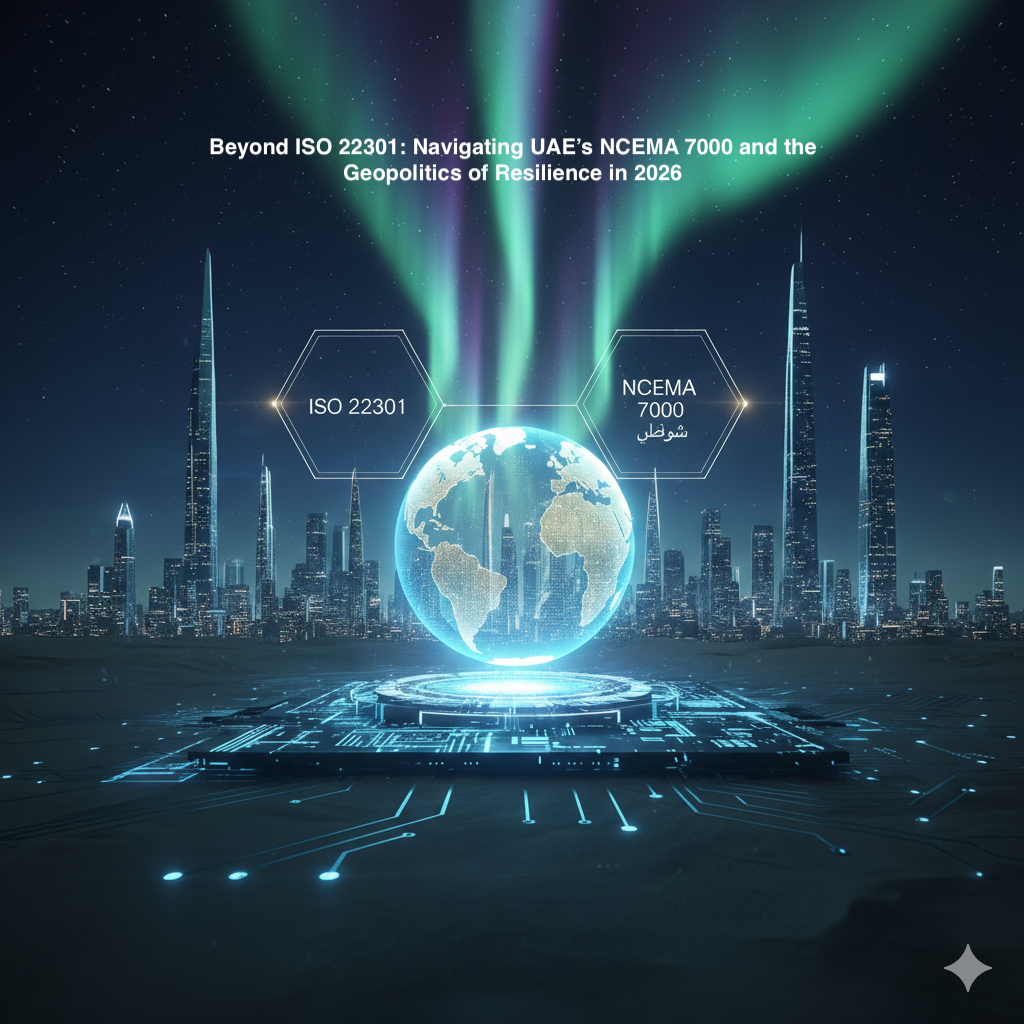
The United Arab Emirates (UAE) has pioneered a rigorous national framework: NCEMA 7000:2021. While aligned with ISO 22301, NCEMA 7000 is specifically designed to protect "Vital Functions" critical to the UAE’s national stability.For European firms, the transition involves more than just a checklist; it requires a deeper integration with UAE-specific threat landscapes and reporting protocols.FeatureISO 22301:2019 (International)NCEMA 7000:2021 (UAE National)Primary FocusGeneral Organizational Continuity National Security & Vital UAE FunctionsAccountabilityManagement-led Direct alignment with National Crisis AuthoritiesThreat LensStandard Business Risks (Cyber, Supply Chain) Regional Geopolitical & Infrastructure RisksMandateVoluntary / Contractual Mandatory for Critical Infrastructure & GovtResilience in the "Grey Zone": Managing US-Iran Tensions
As we move through 2026, the shadow of US-Iran tensions remains a primary driver of risk in the Gulf. For businesses in the UAE, this isn't just a political headlin, it’s an operational bottleneck.The risk of maritime disruption in the Strait of Hormuz, coupled with the heightened threat of "Grey Zone" cyberattacks on financial infrastructure, means that Business Continuity Plans (BCPs) must be dynamic. Our work with top-tier GCC financial leaders has highlighted the necessity of scaling resilience frameworks to withstand not just local disruptions, but regional shocks. When geopolitical friction escalates, impact tolerances are tested in real-time. Resilience Guard helps clients build "Scenario-Neutral" strategies that ensure operations continue whether the disruption is a localized outage or a regional supply-chain fracture.The "Brussels Effect" in the Middle East: DORA & NIS2
Many of our Swiss and European clients are currently navigating the Digital Operational Resilience Act (DORA) and NIS2. There is a strategic advantage here: the Central Bank of the UAE (CBUAE) and regional central banks have introduced standards that mirror the "Impact Tolerance" logic of the EU.If your organization is already "DORA-compliant," you possess the data and the discipline required for the Middle East. Resilience Guard specializes in the "Regulatory Cross-Walk," ensuring that your European compliance efforts are leveraged to meet UAE mandates without duplicating work.Our Regional Expertise: Bridging Switzerland and the GCC
With a track record that includes some of the Middle East’s most significant financial players, Resilience Guard offers a unique bridge between Swiss precision and Gulf-specific requirements.- Proven GCC Track Record: We have successfully adapted global BCM standards for the largest Islamic banking entities in the region, ensuring cultural and regulatory alignment.
- Geopolitical Intelligence: We integrate current regional threat assessments (including US-Iran and Red Sea dynamics) into your Business Impact Analysis (BIA).
- Regulatory Harmony: We align ISO 22301, NCEMA 7000, and CBUAE standards into a single, manageable resilience dashboard.
Conclusion: Resilience is the New Strategy
In 2026, the most successful organizations in the UAE and Europe will be those that view resilience as a competitive differentiator. Compliance with NCEMA 7000 or the CBUAE standards is not just about avoiding fines—it’s about ensuring that your brand is the "Safe Harbor" in an uncertain region.Is your BCM framework ready for the 2026 landscape?Contact our team to learn how we can apply our experience with global banking leaders and European regulators to secure your Middle Eastern operations.FAQ
How does Resilience Guard support BCM in the UAE and Saudi Arabia? Resilience Guard leverages extensive experience with major Islamic financial institutions to implement BCM frameworks that comply with UAE (NCEMA 7000) and Saudi (SAMA) standards, ensuring alignment with both global and local regulations.What are the primary operational risks in the UAE in 2026? Current risks include high-sophistication cyber threats and geopolitical disruptions stemming from regional tensions (e.g., US-Iran). Resilience Guard helps firms build "Impact Tolerances" to withstand these specific "Grey Zone" scenarios.Can ISO 22301 be used for NCEMA 7000 compliance? ISO 22301 is an excellent foundation, but NCEMA 7000 requires additional localized reporting and alignment with the UAE's national vital functions. Resilience Guard specializes in bridging this gap for European firms expanding into the Gulf.Related reading
Start the conversation
Turn analysis into capability.
The practitioners who write these pieces also deliver the work. A confidential conversation, answered within 24 hours.
Book a consultationAll consultations are treated with strict confidentiality.